
How it works#
The board reads the car, runs the model and writes the drive, in that order of importance. Below are the ESP32-S3 figures. On the ESP-Mosaico, the OpenCarMind EdgeOS layer sits on top, see OpenCarMind EdgeOS.
From the car to the card#
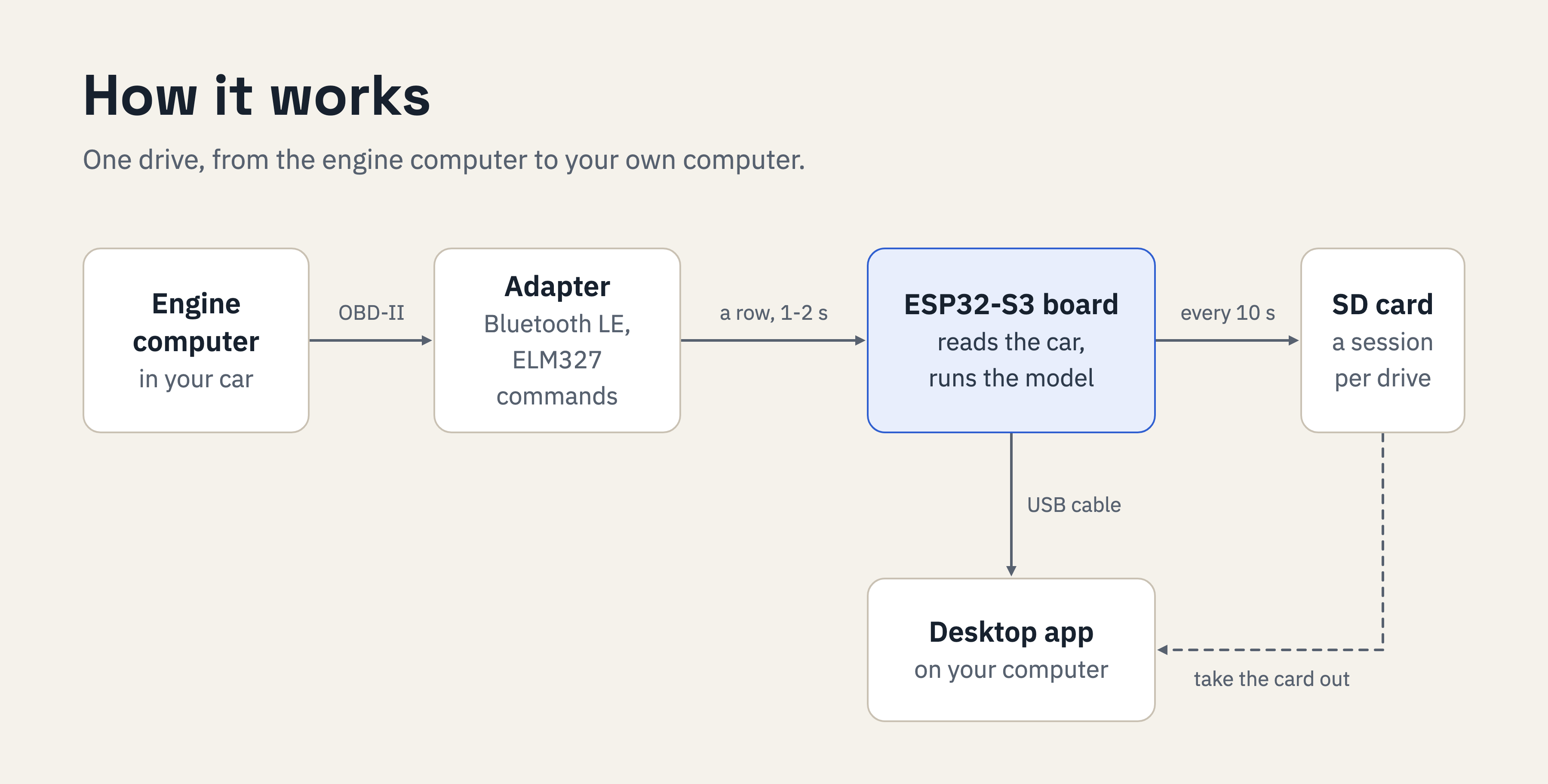
The board asks the engine computer for every field it supports, shows the live values on its screen and writes each drive to the SD card as its own session. At home, the desktop app imports new drives over the USB cable, or you take the card out.
On-board inference#
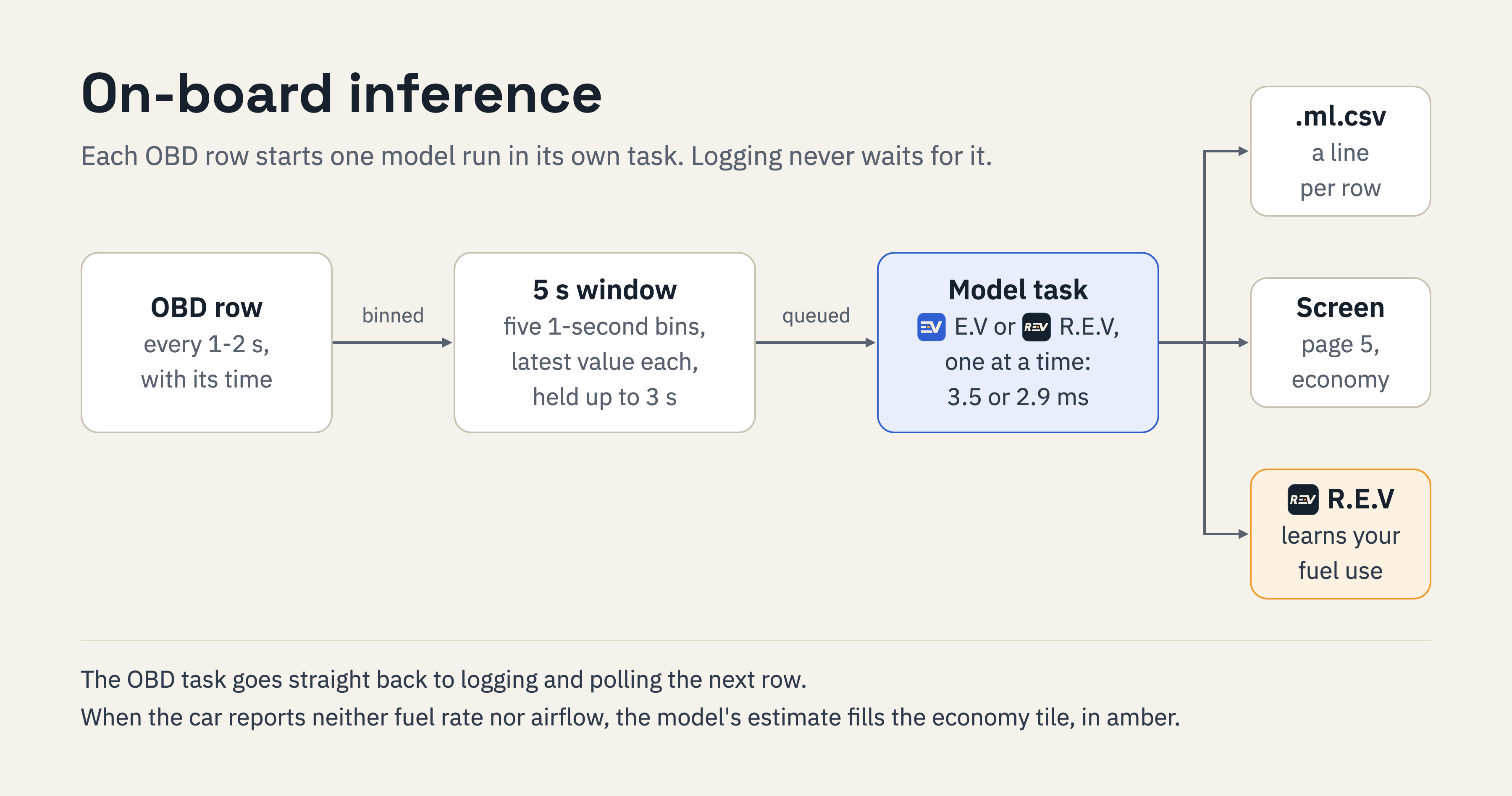
When an OBD row arrives, the board cuts the last 5 seconds into five one-second bins and runs the model in its own task, so logging never waits for it. Every row adds a line to the drive’s .ml.csv file, and the newest answer shows on page 5. With R.E.V, the same run also feeds its learner.
Scheduler and safety#
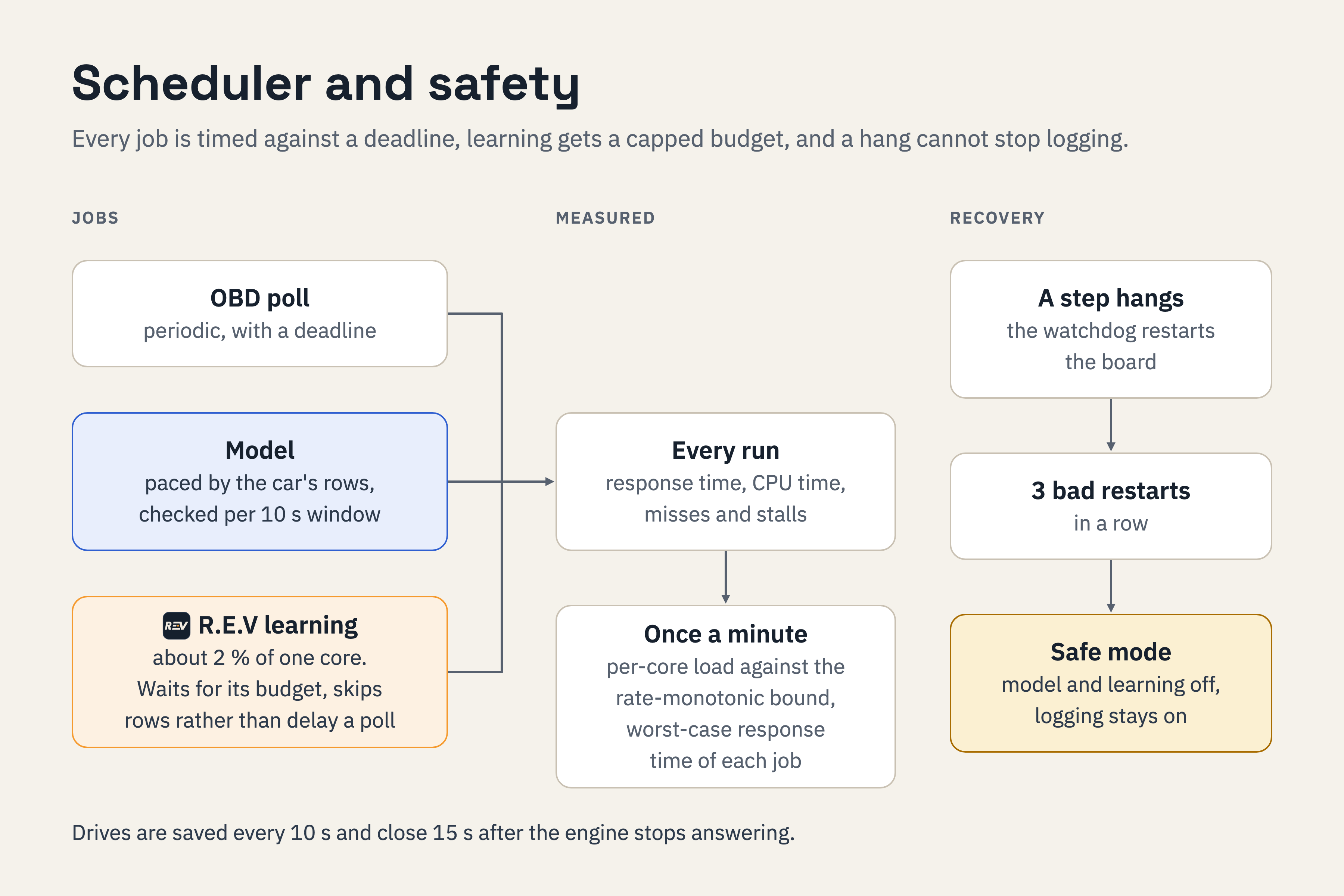
Every periodic job has a period and a deadline. The scheduler in main/sched_mon.c times each run and, once a minute, checks the load against the rate-monotonic bound[4] and each job’s worst-case response time[5]. A step that never returns resets the board, and after three bad restarts in a row it starts in safe mode with logging still on. R.E.V’s learning runs at the lowest priority on a small budget of about 2 % of one core, so it never holds up the OBD poll or the model.
Local-first#
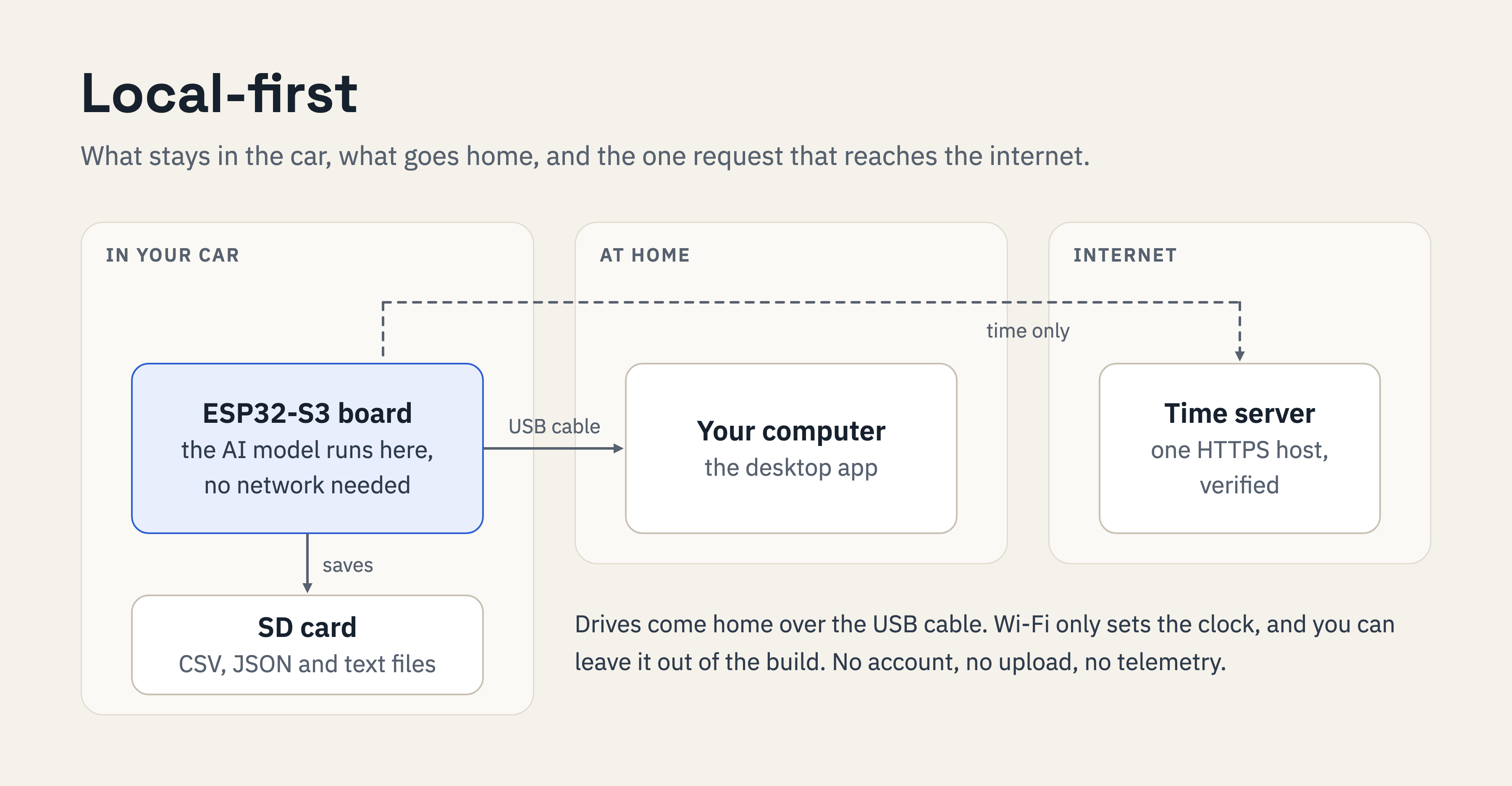
Most car loggers stream your driving to a server and do the thinking there. OpenCarMind does the thinking on the board, the way TinyML work runs networks on microcontrollers[1]–[3]. R.E.V’s learning also happens on the board, and what it learns stays on your SD card. Your data is plain CSV, JSON and text on a card you hold.
Wi-Fi is optional and does one thing: while the car is parked on a known network, the board asks one HTTPS time server for the time. It checks the server’s certificate, sends nothing else, and listens on no port. You can compile Wi-Fi out with OCM_WIFI_CLOCK_SYNC. On the ESP-Mosaico you can also search for a network and join it from the touch screen, for the same clock sync.