Unreleased white paper, open-sourced by Mr Pirate. This is a shortened web edition of "Recent Advances in Quantum Machine Learning: Quantum Gate-Based and Annealing Methods", a review written by Mr Pirate, Huzaifa Khan and Mohammad K Mahad at the Department of Electrical Engineering and Computer Science, University of Missouri-Columbia. It has not been published before. It is part of Mr Pirate's research.
Abstract
Quantum machine learning (QML) uses superposition, entanglement and interference to extend classical machine learning. This review covers its two dominant hardware paradigms. For gate-based (universal) quantum computers it examines variational quantum circuits, quantum neural networks, quantum kernel methods and hybrid quantum-classical designs built for noisy intermediate-scale quantum (NISQ) devices. For quantum annealers it examines quadratic unconstrained binary optimisation (QUBO) formulations for feature selection, clustering and combinatorial optimisation on D-Wave systems. It then compares the two, discusses data encoding, barren plateaus, noise and hardware scaling, and notes that neither paradigm has a provable advantage on arbitrary classical datasets.
I. Introduction
Quantum machine learning has split into two camps that rarely share a page. Gate-based machines from IBM and Google run programmable circuits and can, in principle, compute anything, but noise limits how deep those circuits can go. Quantum annealers from D-Wave cannot run arbitrary programs, but they are good at one job: settling a large optimisation problem into a low-energy answer.
This review puts the two side by side across shallow learning, neural networks, generative models and training (Sections III to V), then asks which paradigm suits which part of a machine learning pipeline (Section VI). Fig. 1 shows the two pipelines.
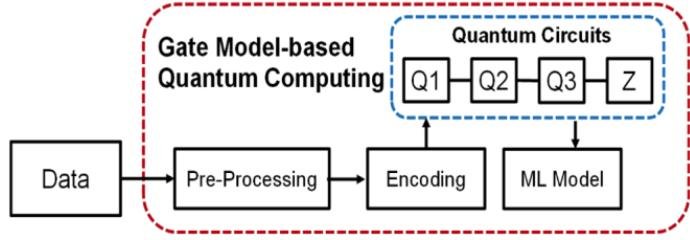
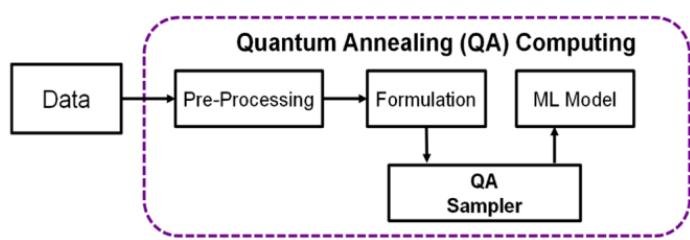
Fig. 1. Examples of quantum ML systems. (a) A gate-based pipeline encodes the data into a quantum circuit. (b) An annealing pipeline turns the learning problem into an optimisation problem and hands it to the annealer's sampler.
II. Background
A. Gate-based computing primitives
A qubit holds a weighted mix of 0 and 1 until it is measured, and n qubits span 2ⁿ basis states at once. Entangled qubits cannot be described one at a time, which is what lets quantum algorithms build correlations a classical machine cannot copy cheaply.
Gate-based machines apply a sequence of reversible gates (rotations, Hadamard, CNOT) to these qubits. On today's noisy hardware the workhorse is the variational quantum algorithm: a short circuit with tunable angles θ prepares a state, the machine measures a cost, and a classical optimiser updates θ in a loop. The parameter-shift rule gives exact gradients from two circuit runs per parameter, which is why this loop has become the standard way to train quantum models. The variational quantum eigensolver and the quantum approximate optimisation algorithm (QAOA) are both built this way.
B. Quantum annealing and adiabatic optimisation
Quantum annealers start every qubit in an easy ground state and slowly morph the system's energy function into one that encodes the problem. If the change is slow enough compared with the smallest energy gap, the system ends in the problem's lowest-energy state.
The problem has to be written as a QUBO, min xᵀQx over binary x, which also covers max-cut, scheduling and the training of Boltzmann machines. Two practical costs come with it. Each logical variable becomes a chain of physical qubits that must stay in agreement (minor embedding), and the chain strength has to be tuned so chains hold without drowning out the problem.
III. Quantum shallow machine learning
Classical statistics leans on matrix inversion, distances and kernels, and each has a quantum counterpart built from resource-efficient "shallow" circuits.
A. Gate-based statistical learning
- Regression and PCA. Quantum linear regression can return the model's classical parameters directly instead of leaving them inside a quantum state. A resonance-based quantum PCA couples a single probe qubit to the system, which cuts the qubit and copy overhead that limited earlier versions.
- Nearest neighbours and clustering. Quantum interference can estimate distances for k-nearest neighbours. Quantum k-means (q-means) relies on quantum memory that today's hardware does not have, and a 2022 hybrid version moves only the expensive distance step onto the quantum processor.
- Kernels. A quantum feature map embeds data in a large Hilbert space, and the processor estimates the kernel from the overlap of two encoded states. Training such a kernel model is a convex problem, so it avoids barren plateaus. On real trapped-ion hardware, though, error mitigation stops being optional.
B. Annealing-based learning
Clustering, support vector machines and boosting ensembles can all be written as QUBOs. A useful side effect is that an annealer returns many low-energy solutions instead of one, which works as a ready-made ensemble of classifiers.
C. Our work: Ising solver chips and quantum boosting
Two of our own papers sit in this section. The Ising solver chip paper (IEEE ICPS 2024) turns a model's training optimisation problem into a QUBO and solves it on a room-temperature CMOS chip instead of a quantum annealer. The battery health paper (IEEE ECCE 2023) trains a boosting model on a D-Wave annealer and tests whether it resists adversarial attacks better than a classical random forest.
IV. Quantum neural networks and generative AI
A. Quantum neural networks
Quantum neural networks have grown from single neurons to deep, layered models.
- A 2019 experiment ran an artificial neuron on an IBM quantum processor, storing an m-bit input in about log₂ m qubits.
- Parameterised quantum circuits treat the quantum computer like a GPU inside a classical training loop, with gradients from the parameter-shift rule.
- Deep quantum neural networks link layers with unitaries and train them two layers at a time, which saves memory, and a later 6-qubit superconducting demonstration showed that reusing qubits can decouple network depth from qubit count.
- Quantum convolutional networks compress inputs with amplitude encoding and share parameters like their classical cousins. Quantum architecture search then automates the choice of gates.
Quantum circuits have also replaced the neural network inside deep reinforcement learning, where they approximate Q-values with far fewer parameters.
B. Our work: quantum CNN malware detection for smart grid devices
Our third paper applies this family to security. The QCNN malware detection paper runs a quantum convolutional circuit on an IBM quantum processor to extract features from malware files turned into images, then hands them to transfer-learned classical CNNs, so one model can adapt to smart grid devices with different processors and operating systems.
C. Quantum generative AI
Classical generative models each pay a price: GANs train unstably, VAEs give blurrier samples, and Boltzmann machines are slow to sample. Quantum versions of these models, and of diffusion models, attack those costs in different ways.
- Boltzmann machines. Training needs samples from the model, which classical Markov chains produce slowly. Annealers sample Boltzmann-like distributions natively at low temperature.
- Quantum GANs. Generators of 8 to 12 qubits can learn useful image distributions when paired with classical discriminators. Fully quantum GANs compare states by fidelity, a distance that sees quantum correlations. The studies reviewed report similar output quality from far fewer trainable parameters, plus uses in drug design, entangled-state generation and materials design.
- Diffusion. The forward-and-reverse noising idea has been carried over to quantum states, with circuits trained to undo quantum noise channels.
Training complexity, barren plateaus and hardware noise still cap how far these models scale, so the review expects the first wins in problems that are quantum to begin with: chemistry, physics and huge discrete search spaces.
V. Training optimisation
The hardest open problem in QML is the gradient, more than the model.
A. Barren plateaus and gradient methods
For randomly initialised circuits, gradients shrink exponentially with qubit count [4]. Hardware noise flattens the cost surface further as circuits get deeper.
Problem-inspired ansätze, layer-by-layer training, careful initialisation and local cost functions all reduce the problem. Quantum natural gradient follows the geometry of the quantum state space instead of raw parameter space, and general parameter-shift rules now cover gates that the original two-point rule did not.
B. Local traps and optimiser choice
Even circuits that avoid barren plateaus can be swamped with poor local minima, which points to a hardness that a better optimiser alone will not fix. A 128-page review of the variational quantum eigensolver found that no single optimiser wins everywhere, and that a well-chosen ansatz matters more.
C. Tuning quantum annealers
Annealing has its own knobs. Chain strength has to be set so chains hold without distorting the problem. A learning agent can rewrite the problem's Ising Hamiltonian between runs and find better solutions with fewer samples [7]. Higher-order constraints can be split into pairwise ones with auxiliary qubits. Several small problems can share one anneal, which trades a little solution quality for a large gain in time to solution [6].
VI. Discussion: which paradigm fits which job
Table I condenses the review's central comparison.
Table I. Gate-based circuits and quantum annealing for machine learning
| Gate-based circuits | Quantum annealing | |
|---|---|---|
| Programming model | Universal circuits of gates | One fixed process: anneal a QUBO or Ising problem |
| Natural ML role | Feature maps, kernels, neural-network-like models trained by gradient | Discrete training problems, sampling for energy-based models, combinatorial steps in a pipeline |
| Main hardware limit | Noise and short coherence cap circuit depth | Sparse qubit graphs force embedding chains, and QUBO conversion adds variables |
| Main training problem | Barren plateaus and local traps | Chain strength, annealing schedule and problem scaling |
| Strongest near-term use | Small, structured models and quantum data | Optimisation-heavy training and sampling |
Our reading of the literature is that the field has moved past toy problems. The open questions are now engineering ones: how to load classical data into quantum states without losing the speedup, how to keep gradients alive, and how to map real constraints onto real annealer hardware. Neither paradigm has shown a general advantage on arbitrary classical datasets. Both are most useful today as one stage inside a hybrid quantum-classical pipeline, with each part of the problem sent to the hardware that suits it.
VII. Conclusion
Shallow learning, quantum neural networks and quantum generative models each bring something classical methods cannot do cheaply, but the gap between theoretical and demonstrated advantage is still wide. Closing it needs error correction and mitigation, better circuit design, training methods that survive rough cost surfaces, and pipelines that send each task to the hardware best suited to it.
That last point runs through our own work. We use annealers and Ising chips for the optimisation inside training, gate-based circuits for feature extraction, and classical hardware for everything else.
Acknowledgment
The three authors contributed equally to the literature review and the references. They thank Prof. Dong Xu for his guidance on contrastive learning, diffusion models and generative models.
Frequently asked questions
What is the difference between gate-based quantum computing and quantum annealing?
A gate-based computer runs a programmable sequence of quantum gates and is universal in principle. A quantum annealer runs one fixed physical process that settles an optimisation problem into a low-energy state, so it only solves problems written as QUBO or Ising models.
Is there proof that quantum machine learning beats classical machine learning?
Not for general classical datasets. The review finds advantages on specific structured problems and in parameter efficiency, but no demonstrated advantage on arbitrary real-world data with today's hardware.
What is a barren plateau?
A region of a quantum model's cost surface where gradients are exponentially small in the number of qubits, so gradient-based training stalls. Random initialisation and hardware noise both cause it.
Why is this paper published here instead of in a journal?
It was written as a group review and has not been published before. Mr Pirate is releasing a shortened version openly so that the comparison and the references are useful to other people.
References
- Mr Pirate, Khan and Mahad, "Recent Advances in Quantum Machine Learning: Quantum Gate-Based and Annealing Methods", University of Missouri-Columbia, unpublished review.
- Preskill, "Quantum computing in the NISQ era and beyond", Quantum 2, 79 (2018).
- Cerezo et al., "Variational quantum algorithms", Nature Reviews Physics 3, 625 to 644 (2021).
- McClean et al., "Barren plateaus in quantum neural network training landscapes", Nature Communications 9, 4812 (2018).
- Havlíček et al., "Supervised learning with quantum-enhanced feature spaces", Nature 567, 209 to 212 (2019).
- Pelofske, Hahn and Djidjev, "Parallel quantum annealing", Scientific Reports 12, 4499 (2022).
- Ayanzadeh, Halem and Finin, "Reinforcement quantum annealing: a hybrid quantum learning automata", Scientific Reports 10 (2020).
- Farhi, Goldstone and Gutmann, "A quantum approximate optimization algorithm", arXiv:1411.4028 (2014).
- Mr Pirate et al., "Quantum convolutional neural network-based online malware file detection for smart grid devices", IEEE (author's manuscript).
- Mr Pirate, Khot and Kim, "Quantum annealing-based machine learning for battery health monitoring robust to adversarial attacks", IEEE ECCE 2023.
- Khot, Kim, Mr Pirate, Kim and Moy, "Quantum-inspired machine learning framework using a physics-based Ising solver chip", IEEE ICPS 2024.